Peak Oil Explained in a Nutshell
"Peak oil is the point in time when the maximum rate of global petroleum extraction is
reached, after which the rate of production enters terminal decline." That is
Wikipedia's definition of peak oil.
The Earth's total endowment of oil, before humans started using it, was roughly 2
trillion barrels of recoverable oil. Consumption has been rapidly increasing and about
half is used up. Consumption is currently 31 billion barrels each year. Crunch the
numbers and you will see the oil gone in 32 years presuming the rate of consumption
does not change. That is not to be construed to mean that world oil production will be
constant for 32 years and then suddenly go to zero.
There will be demand for oil, even if it is expensive. Billions of prosperous people
in China and India will guarantee that.
The problem is oil production. Very little oil has been found within the past 30 years
and the prospect of finding much more is dim and it's not for lack of looking.
Obviously, oil must be found before it can be produced. Some of the world's oil
producing regions have already experienced steep declines. It happened in the US in
1971. It happened in the North Sea in 1999. It happened in Mexico in 2006. Oil
production in the Middle East and the Russian Federation has not yet peaked, but it
will eventually. Peak oil production does not mean the oil is gone. It means all
efforts to increase the oil production rate fail.
Peak Oil occurs when the declines overwhelm the increases.
A Growing Awareness of Peak Oil
Oil geologists, oil company executives and most scientists know that an oil crisis is
nearly upon us. World peak oil production is about to happen with profound
implications for everyone. In a few years—within the decade—world oil
production will decline—slowly at first but then accelerating.
Politicians, economists, financiers and the general public are generally less aware of
peak oil—but that is changing.
Some Politicians are Aware of Peak Oil
 Clearly Roscoe Bartlett, Congressman from Maryland, is aware of
Peak Oil. He gave a speech in April of 2005 entitled "Our Dependence on Foreign Oil."
The speech was also an open letter to the president signed by many prominent people
including 12 retired generals and admirals, five Secretaries of Defense, and several
retired Senators and Representatives. In his speech he ruefully admits that had he
given his speech a few years earlier, he would have been consigned to the same loony
bin reserved for wackos.
Clearly Roscoe Bartlett, Congressman from Maryland, is aware of
Peak Oil. He gave a speech in April of 2005 entitled "Our Dependence on Foreign Oil."
The speech was also an open letter to the president signed by many prominent people
including 12 retired generals and admirals, five Secretaries of Defense, and several
retired Senators and Representatives. In his speech he ruefully admits that had he
given his speech a few years earlier, he would have been consigned to the same loony
bin reserved for wackos.
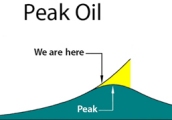 This graphic appears 4 times in Bartlett's speech!
He must think the concept of Peak Oil is important. The letter also points out that
"we have only 2 percent of the world's oil reserves, we use 25 percent of all of the
oil used in the world, and we import two-thirds of that. We have less than 5 percent
of the world's population." The speech can viewed as a pdf document here:
This graphic appears 4 times in Bartlett's speech!
He must think the concept of Peak Oil is important. The letter also points out that
"we have only 2 percent of the world's oil reserves, we use 25 percent of all of the
oil used in the world, and we import two-thirds of that. We have less than 5 percent
of the world's population." The speech can viewed as a pdf document here:
http://planetforlife.com/pdffiles/energyspeech.pdf
The speech can be viewed as a video here:
http://www.energybulletin.net/5080.html
Roscoe Bartlett's website:
http://www.bartlett.house.gov/
Congressman Bartlett made a more complete version of this speech before Congress in
2006. (See the side bar.)
Congressman Bartlett is not the only politician warning about peak oil. For example,
former Secretary of Defense James Schelsinger made a statement before the Senate on 16
November 2005. (See the side bar.)
Oil Companies are Talking about Peak Oil
The major oil companies know about peak oil. It must be a topic in boardroom
discussions. Although oil is profitable now, they know that oil is not the future. Oil
companies actually place ads in major newspapers or magazines that seem to say that
oil is not the future.
"Energy will be one of the defining issues of this century. One thing is clear: the
era of easy oil is over. What we all do next will determine how well we meet the
energy needs of the entire world in this century and beyond.
 This sounds like a quote come from some
wacko environmentalists. Actually it is the first paragraph of a two page ad placed in
the July 25, 2005 issue of The New Yorker. It is from David J. O'Reilly, Chairman
& CEO, Chevron Corporation, a major oil company. You can see the ad
This sounds like a quote come from some
wacko environmentalists. Actually it is the first paragraph of a two page ad placed in
the July 25, 2005 issue of The New Yorker. It is from David J. O'Reilly, Chairman
& CEO, Chevron Corporation, a major oil company. You can see the ad
http://planetforlife.com/pdffiles/manifesto.pdf
The ad refers to a website:
http://willyoujoinus.com/
The chevron logo is extremely inconspicuous. It exhorts people to conserve energy.
Most major oil companies are placing similar ads, but the Chevron ad is clearer than
most. The oil companies seem to know an oil crisis is imminent.
The General Public is Learning About Peak Oil
 The June 2004 issue of National Geographic has an article whose full
title is: "Think gas is expensive now? Just wait. You've heard it before, but this
time it's for real: We're at the beginning of the end of Cheap Oil."
The June 2004 issue of National Geographic has an article whose full
title is: "Think gas is expensive now? Just wait. You've heard it before, but this
time it's for real: We're at the beginning of the end of Cheap Oil."
http://magma.nationalgeographic.com/ngm/0406/feature5/index.html
 PBS
(Public Broadcasting Service) aired a series of programs entitled Extreme Oil. An
online version of the series may be found at
PBS
(Public Broadcasting Service) aired a series of programs entitled Extreme Oil. An
online version of the series may be found at
http://www.pbs.org/wnet/extremeoil/
Here is a quote from the PBS site: "Fifteen years after the end of the Cold War and in
the wake of two wars in the Gulf and Iraq, all the world's easy oil has been
found."
The major news magazines are publishing articles about peak oil. For example: Time
Magazine published The Real Oil Shock by Matthew Simmons 26 September 2005 and
also It's the End of Oil by Kenneth Deffeyes 31 October 2005. U.S.News and
World Report published Hostage to Oil 10 January 2005.
